by Simon Schöpf
Three sounds remain etched in my memory from that day: the whistling of the marmots at the Access, the whistling of the wind through the rock face, and the whistling of the drill as it bored into the rock.
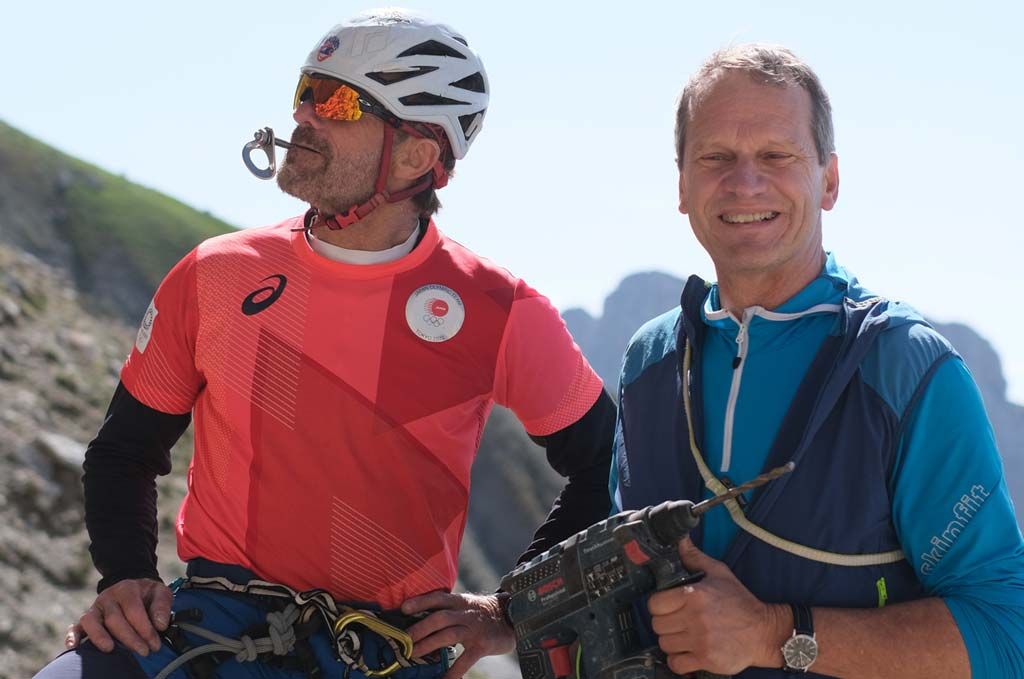
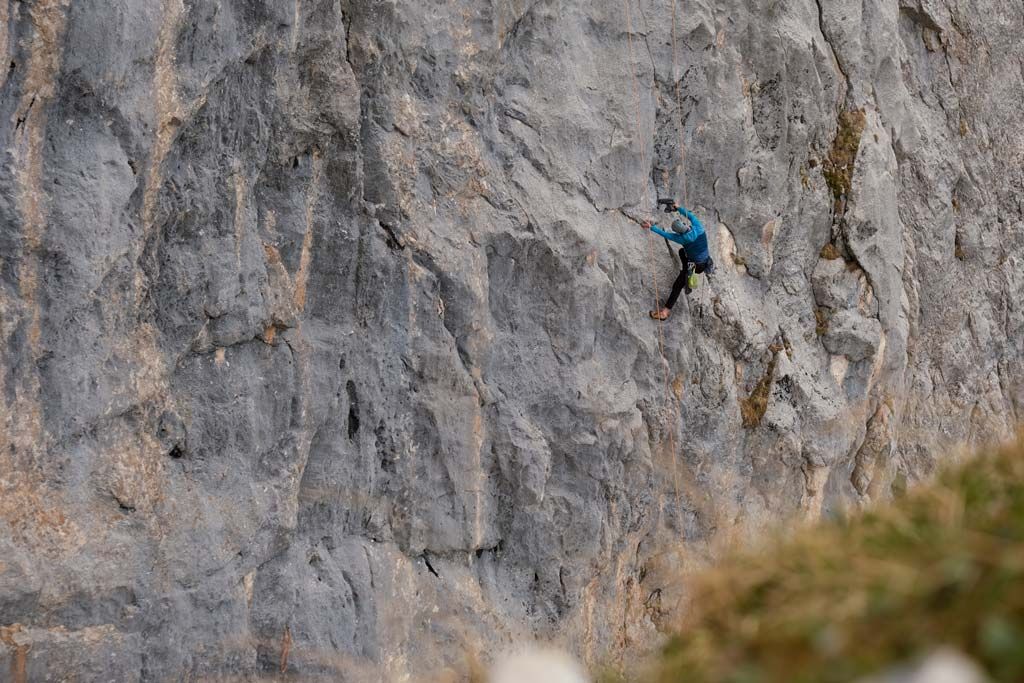
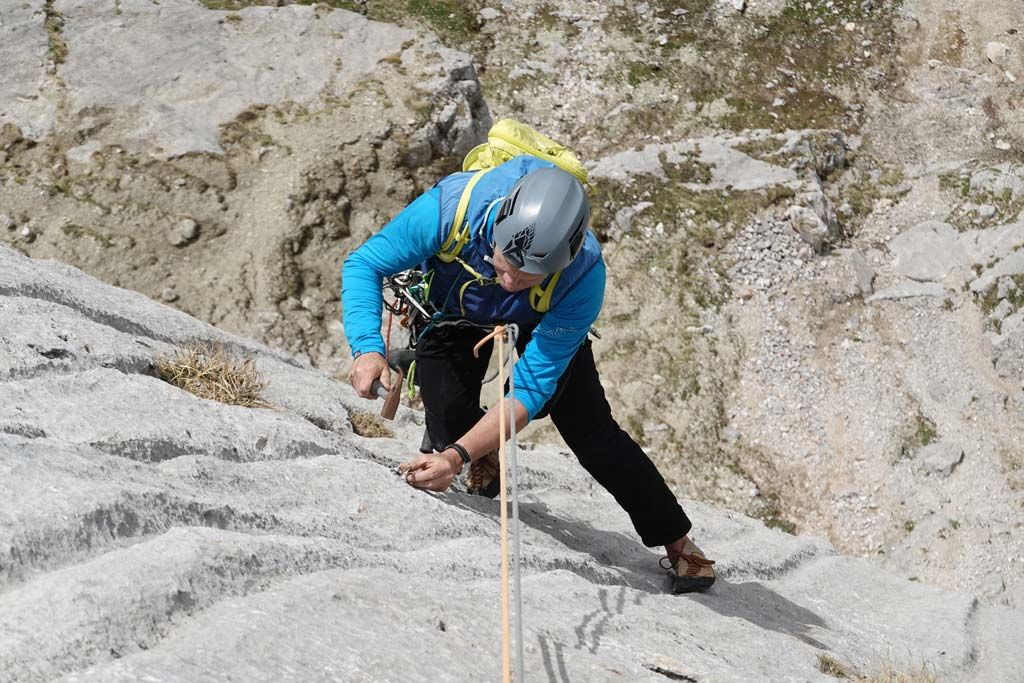
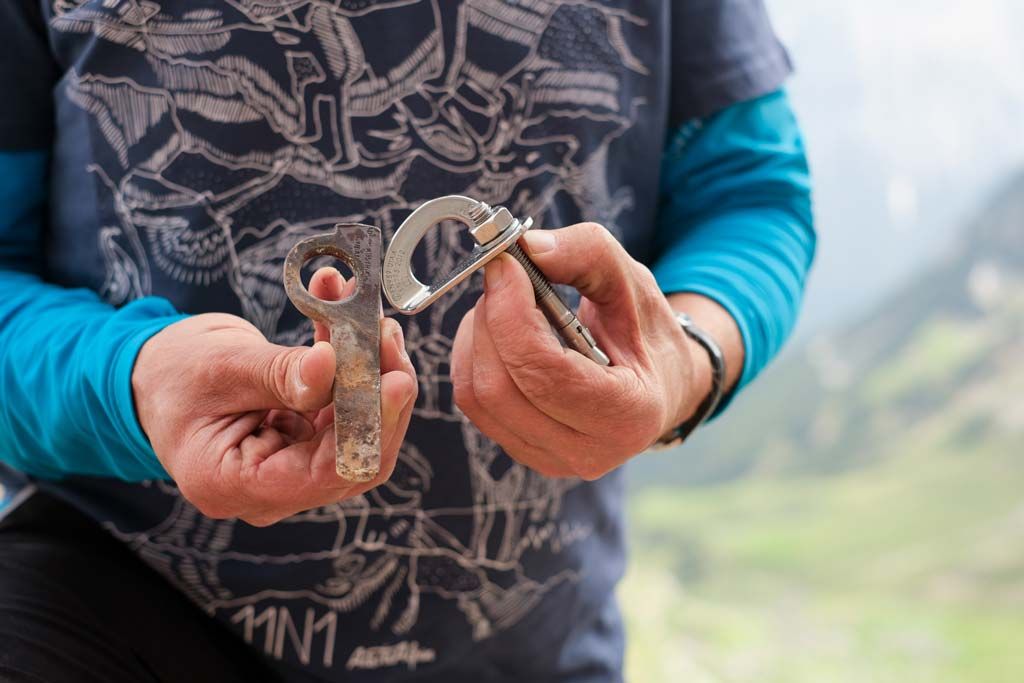
Well, ‘whistling’ might be a euphemism – the Bosch 18V simply does what drills do: make noise. But only for a very short time; 25 seconds later, the wind is back to providing the background noise. This is followed by a few rhythmic hammer blows to drive the express anchor into the freshly drilled hole, a few turns of the spanner – and the bolt is in place. “There you go, Luis, that’ll hold for the next 100 years,” says Thomas, abseiling a few metres down to find the perfect spot for the next one.
Thomas Schöpf is my father; Luis Knabl is his oldest climbing partner. Most marriages don’t last anywhere near as long as the 45 years the two of them have spent scaling steep walls together. The three of us are hanging in a grey sea of limestone in the Wetterstein Mountains, that rock-climbing mecca where climbing history was once reliably made: the ‘Morgenlandfahrt’, the ‘Bayerische Traum’, the ‘Locker vom Hocker’ – all iconic routes, pioneered by the ‘who’s who’ of the climbing elite of the time.
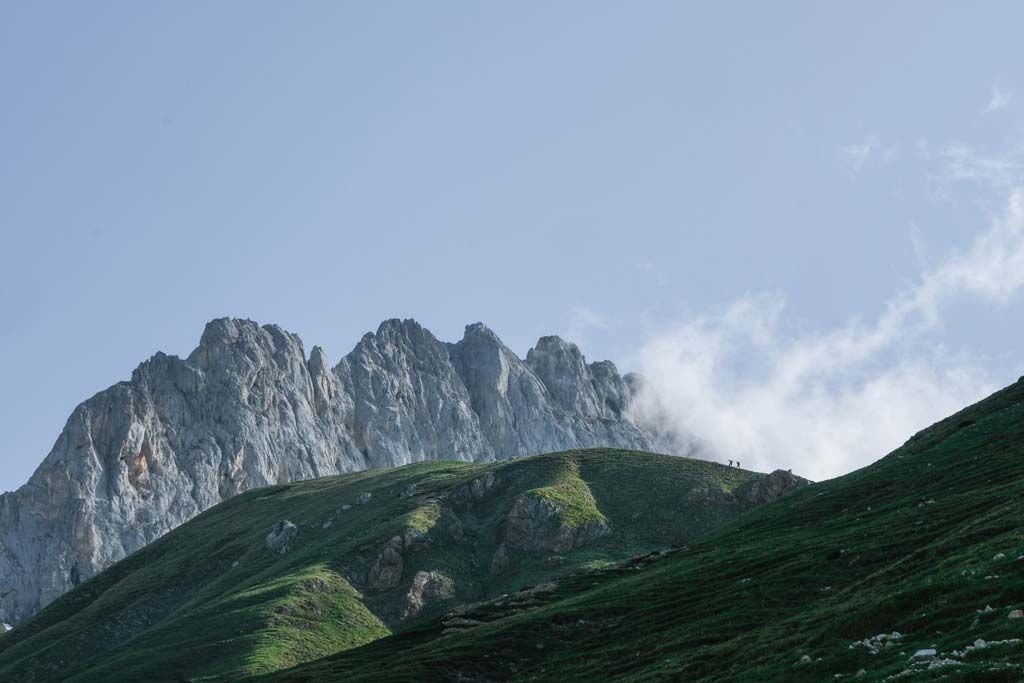
These evocative names can be found on the southern cliffs of the Schüsselkarspitze, not far from the legendary ‘Chinesische Mauer’ Rock Climbing Area. We’re a few hundred metres further west, on the neighbouring peak of the Scharnitzspitze. Here, the face isn’t quite as high or as steep, but the rock quality is the same – and, above all, it isn’t quite as heavily bolted. Even today, there’s still uncharted territory here for first ascents.
But why do people bolt climbing routes in the first place? “At some point, you want to make your own contribution and leave something behind. In my case, that just happens to be well-secured Multi-Pitch Climbing routes that you can climb without fear or the fear of death – something suitable for family men and pensioners,” says Thomas. The pair used to make an annual pilgrimage to the south of France, to the Verdon Gorge and Briançon – places where, even back in the 1980s, you could climb without automatically feeling existential dread. Inspired by the French, as early as 1993 they completed what may well have been the first first ascent in the Wetterstein range secured exclusively with adhesive bolts: ‘Mon Chéri’, seven pitches up to 8-, on the Schüsselkarspitze. This was followed in 2000 by “Wolke Sieben” (7 pitches, 7+), which Thomas opened with Andi Klotz.
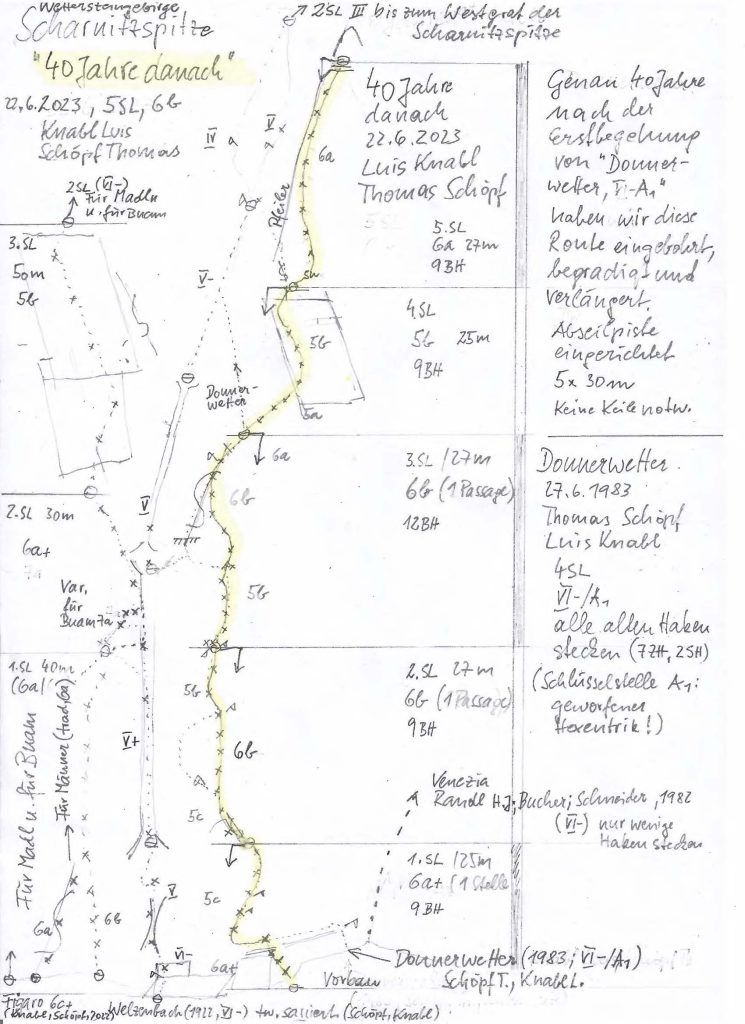
A testament to more terrifying days is the mouldy sling that we can see flapping in the wind from our belay station. “That’s still ours, from the very first attempt at this first ascent. It’s been hanging there for 38 years now,” says Thomas. Back then, he and Luis had once again headed up into the Wetterstein, equipped as usual with a hammer, pitons and nuts. The line they’d had in mind came to nothing – a thunderstorm had soaked the wall. Only a narrow strip on the Scharnitzspitze was, miraculously, dry, so the two of them climbed up there. ‘Donnerwetter’ is the name of the route as they remember it; it was never published.
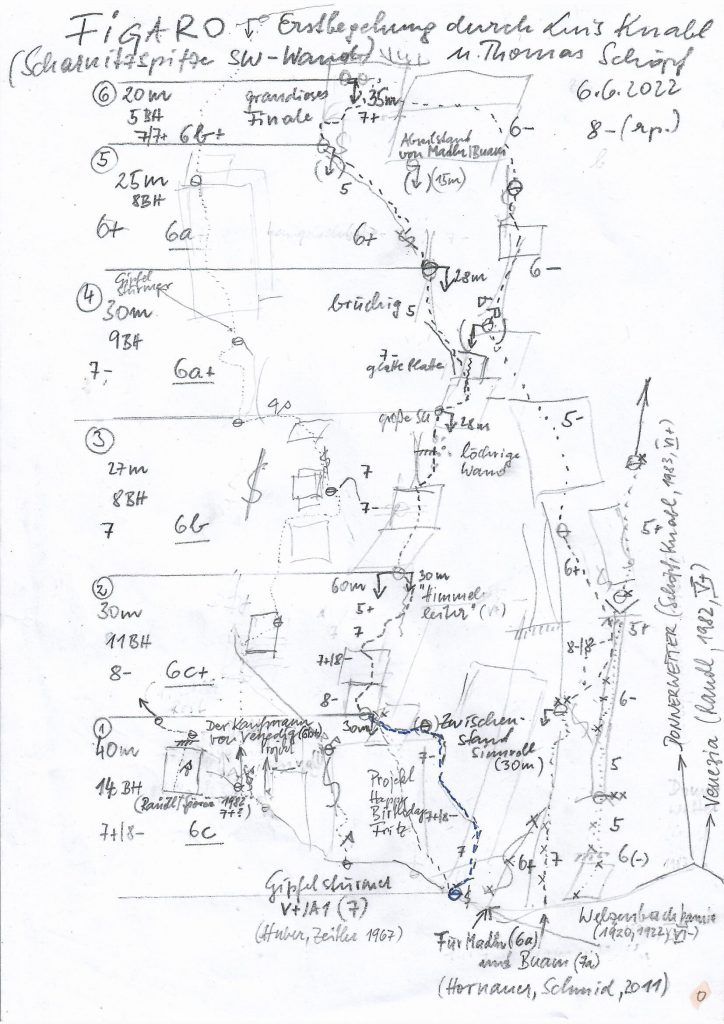
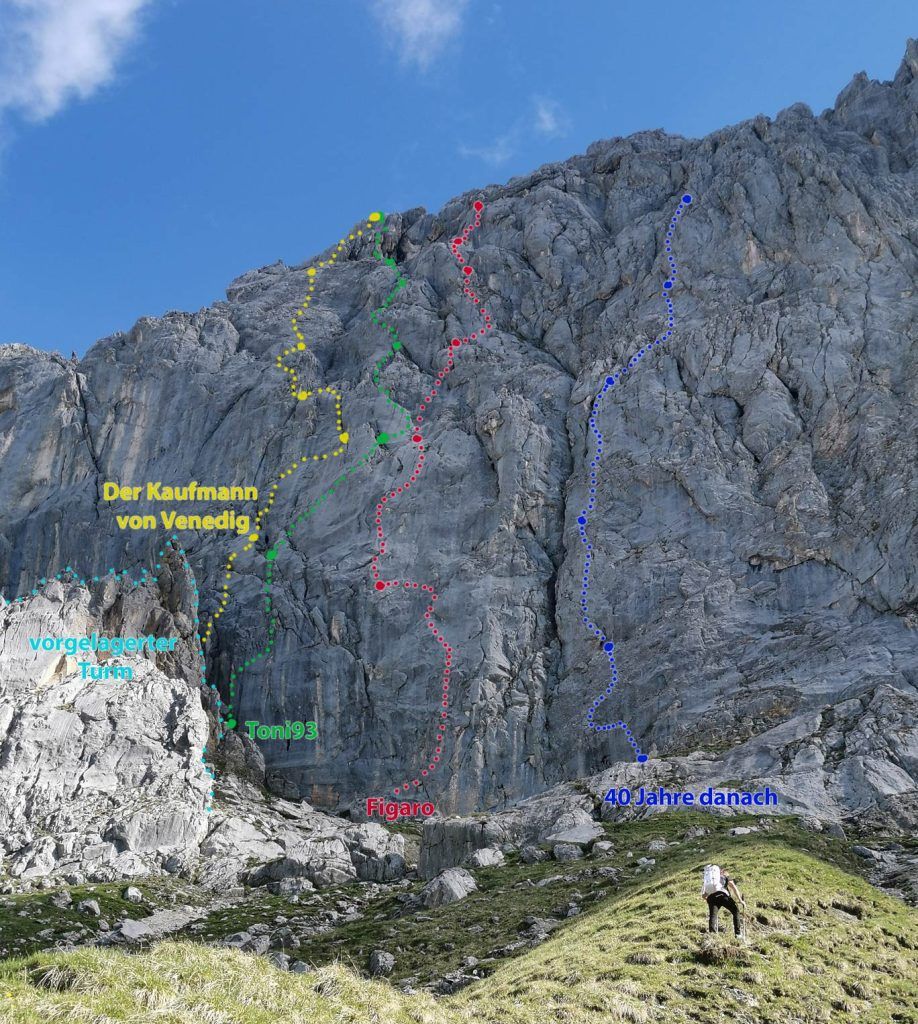
So now: drill in the bolts, make it accessible for posterity. The new route is to be called ‘Figaro’ – Italian for ‘barber’, which is what Luis was until his retirement in nearby Telfs. With a few adjustments, the original ‘Donnerwetter’ becomes ‘The Merchant of Venice’.
Drawing lines
The bolt is arguably the invention that has most profoundly changed climbing. The movement on the rock is the same; it’s just that the consequences in the event of a fall are fundamentally different. “If you’d climbed the ‘Leberle’ (4+), you were already someone,” recalls Luis. Those who enjoy a mental challenge will still find plenty of wild routes. But anyone who simply wants to enjoy a delightful day’s climbing in the stunning surroundings of the Wetterstein can now head for the south faces of the Scharnitzspitze – and instead of starting on the ‘Donnerwetter’ and swearing, climb the ‘Figaro’ and simply enjoy life.
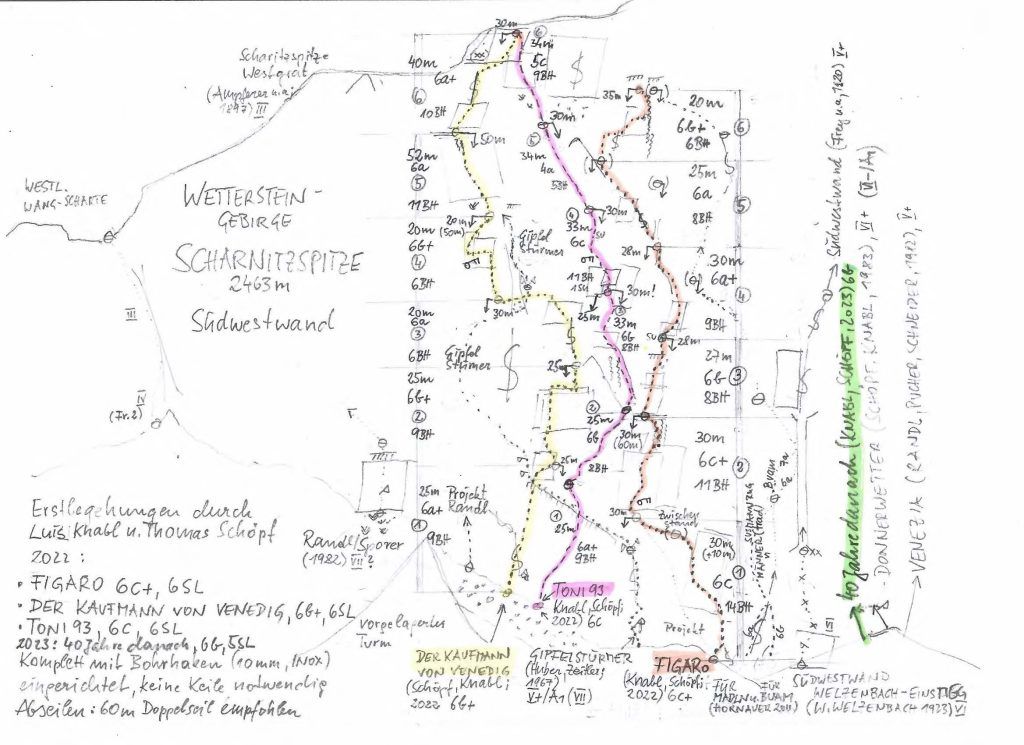
Route: The ‘Figaro’ (6c+/7a or 8-/8) is situated on the left-hand side of the Scharnitzspitze, just to the left of ‘Für Madln und Buam’ (8-/8), and was completed in June 2022.
Access: From Gaistal in Leutasch, it is best to cycle to the Wangalm on an E-Bike; from there, it is a good hour of hiking to the walls of the Scharnitzspitze, which are already visible.
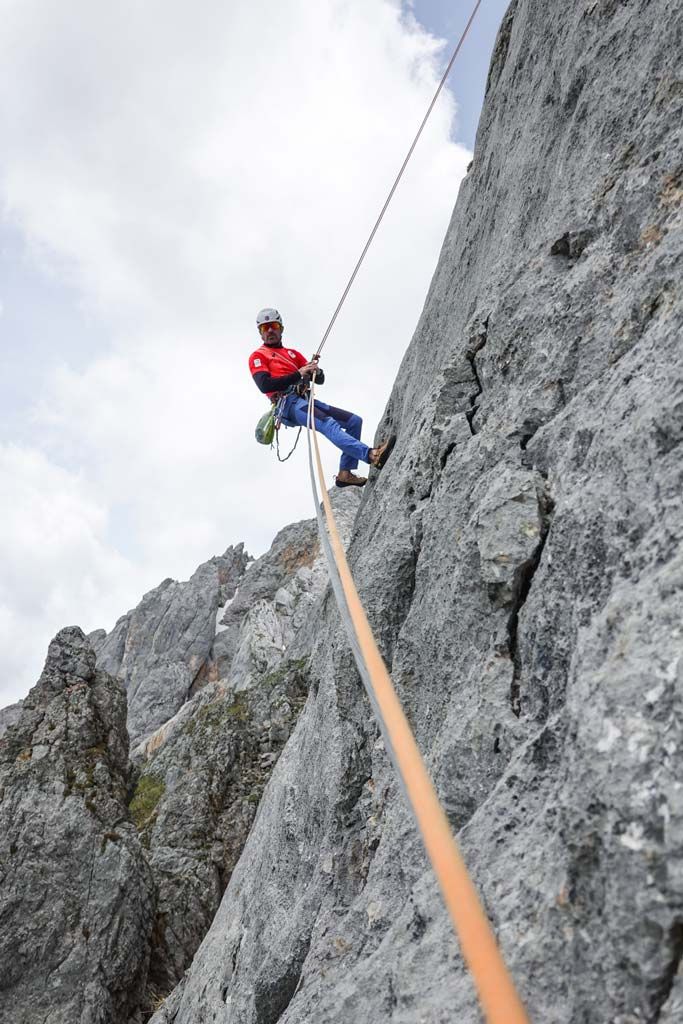
Descent: Abseil down the route using a double rope – a 70-metre single rope can also be used.
Equipment: Thanks to our Climbers Paradise partner AustriAlpin for the gear!
Literature: “Wetterstein Süd” by Grübler/Hangl/Neuner, Panico Alpinverlag, 3. edition 2016.
A lot has happened on the south face of the Wetterstein since the Figaro: Thomas Schöpf and Luis Knabl, together with their friends, are currently among the most active route-setters in the region. Here is an overview of the new, well-secured Gourmet Tours. The access from Gaistal in Leutasch involves Mountain biking (on an E-Bike) to the Wangalm, followed by a walk of around an hour. The topos are available to download from the relevant linked page on the Innsbruck Climbing Centre website.
Figaro Sector – Scharnitzspitze South-West Face (6b–7a)
Five leisure routes, fully equipped with 10 mm stainless steel bolts (60 m twin rope required for abseiling):
Topography & details for the Figaro sector
Aperitivo sector – Oberreintalschrofen south face (6a–7b)
Footwork-intensive slab and wall climbing on rough, solid Wetterstein limestone; wall height approx. 100 m. Pioneered by Fritz Huber, Thomas Schöpf, Florian Leitgeb, Luis Knabl and Christian Tollinger. Equipment: 16 quickdraws, 70-metre single rope or 50-metre twin ropes.
Topography & details for the Aperitivo sector
The Creation – Oberreintalschrofen South Pillar (7a, 9 pitches/230 m)
First ascended in November 2024 by Thomas Schöpf together with his son Simon. Varied climbing from a hole overhang via steep cracks to a technical slab crux, on top-quality Wetterstein limestone. Equipment: 12 quickdraws; Friends (0.75, 1, 2) are recommended for pitches 2 and 3; 4× abseils (60 m).
Topography & details on the route
“Nebenbuhler” & “Zum Pool” – Oberreintalschrofen South Pillar
Topography & details on Nebenbuhler & Zum Pool
Triathlon sector – Oberreintalschrofen south face approach (6b–6c+)
Three routes up to 6 pitches, first ascended by Luis Knabl and Thomas Schöpf in 2025 (the final route, ‘Triathlon’, was completed in early December 2025). Absolutely superb rock, reasonable bolting. Equipment: 50-metre twin rope or 70-metre single rope, 10 quickdraws. Anyone who climbs all three routes in a single day has passed the Triathlon.
Tips & Safety
Would you like to know more about climbing safety? Click here for our safety tips.