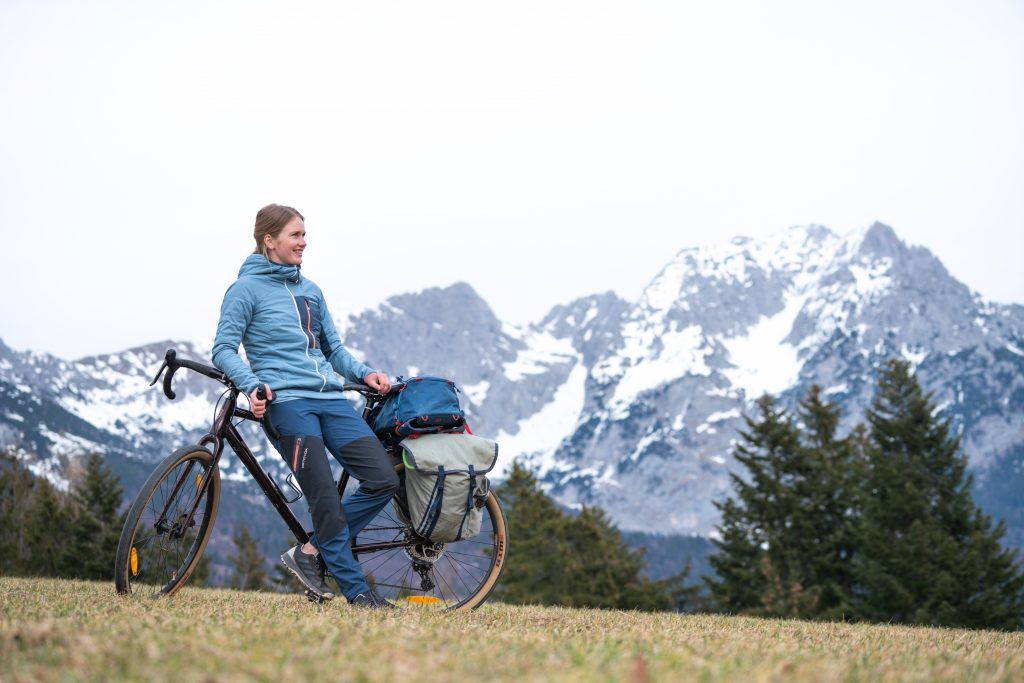
She’s already looking radiant this morning: Lena Müller has just returned from a trip to Arco – she travelled without a car, using only the train and her bike. A hassle or a liberating experience? For Lena, the answer is clear.
Interview: Simon Schöpf
Ever since she became the first German woman to climb an E9/E10 route – the trad testpiece ‘Prinzip Hoffnung’ – two years ago, Lena Müller has made her mark on the climbing scene in the media. We speak to the Allgäu native, who lives in Innsbruck, about climate-friendly climbing, her work as a climate researcher, the freedom to act, and her new project: the sustainable climbing guide for Tirol.
Simon Schöpf: In Ortovox’s film project ‘Alpen – to go?!’, we see you carrying out fieldwork as a climate researcher in the Stubai Valley and climbing in the Karwendel Mountains. What are you currently working on?
“In my PhD thesis, I’m looking at the effects of the climate crisis – particularly increasing droughts – on mountain regions. To this end, we’re conducting experiments in the Stubai Valley and at the Innsbruck Botanical Garden.”
The film states: “We are in the process of destroying what we love and need. And we know it.” Knowledge is one thing, action another – how do you reconcile these two conflicting impulses within yourself?
“For me, the two go hand in hand: knowledge and action! The main reason I personally made changes in my own life was my awareness of the impacts of the climate crisis. Through my degree in ecology and now my PhD, I’ve engaged with the subject so deeply – at some point, this gave rise to a need to bring about practical change.”
Theoretical question: Would you still cycle to the Rock Climbing Area if you hadn’t studied ecology?
“That’s a very good question and a really difficult one to answer. In fact, perhaps not. For me, grappling with the climate crisis during my studies and research was the catalyst for changing many aspects of my life – including, ultimately, how I get to my sporting activities. I felt it wasn’t enough to stop eating meat and buy organic, yet still whizz off to the crags by car a few times a week. But my answer also highlights a major problem: the climate crisis is an information crisis! Politicians and the media aren’t providing us with sufficient or honest enough information about what lies ahead.”
What consequences can we expect if we continue with ‘business as usual’?
“If politicians fail to act and do not limit global warming to 1.5 degrees by the end of the century, the consequences will be dramatic: rising sea levels, drinking water shortages, increased crop failures, floods and a dramatic decline in biodiversity. The impacts are distributed extremely unevenly across the globe – both the consequences and the opportunities for adaptation.”
You’re setting a good example: films, posts, conversations. Is that catching?
“I really do hope it is contagious! I’ve now received a great deal of positive feedback, even from people I don’t know at all. Ever since I climbed the ‘Prinzip Hoffnung’ route in Bürs, I’ve been lucky enough to keep getting requests on this topic – the chance to speak about it publicly. All this feedback shows you that you’re not alone, that it’s a shared concern, that we’re a community. If that weren’t the case, I couldn’t do this!”
“But it’s still difficult to find someone who fancies travelling by public transport to go climbing. I’m optimistic, though.”
Which climbing areas do you like to hang out in the most – and which crags are easiest to reach by public transport?
“In winter, I absolutely love going to the Martinswand; it’s really easy to get there by bus or train. These days, I also often head to the Kufstein area because it’s easy to get there by train – and I like to take it easy. The Geisterschmiedwand is brilliant – really good climbing: if you take your bike on the S-Bahn, you’re at the crag in 10 minutes from the station. The Morsbach Rock Climbing Area is also good, as is Sparchen – it’s about a 20-minute cycle there.”
You’re also working on a sustainable climbing guide. Tell us more!
“We’re going to press next week! I’ve put the climbing guide together with my girlfriend, Deniz Scheerer. In it, we showcase Rock Climbing Areas in Tirol that are easily accessible from Innsbruck by public transport or bike. The focus is on travel instructions: our aim is to make climate-friendly climbing easier and to keep the barrier to entry as low as possible. We hope that our guide will make it easier for more and more climbers to leave their cars at home every now and then.”
“Climate-Friendly Climbing – A Guide to Travelling by Bus, Train and Bike in Tirol” is available free of charge as a PDF online.
Tips & Safety
Would you like to find out more about climbing safety? Click here for our safety tips.