
Difficulty:difficulty: 3 - 7Place:Karres / Outdoorregion Imstroutes:119 routes


Rock Climbing Areas don’t just drill themselves: just how much work actually goes into setting up and maintaining them? And who looks after these building sites on the mountain? Out and about with a helmet, a hammer and a drill.
Just how much work actually goes into setting up and maintaining Rock Climbing Areas? And who looks after these construction sites on the mountain? Out and about with a helmet, hammer and drill.
If we’re honest, this is usually how it goes: you arrive at a Rock Climbing Area with a group of good friends, have a chat, start on the first route, clip into the belay carabiner, abseil down again – everything’s fine. Rarely do we ask ourselves how the bolts we clip in so unquestioningly actually end up in the rock; we simply trust them blindly. But the outdoors isn’t a climbing centre: especially over the winter, with extreme temperature fluctuations throughout the seasons, with rainfall, with wind … a mountain range is constantly changing.
The quality standards that Climbers Paradise Tirol has set for itself are arguably unique in the Alps. But a Rock Climbing Area isn’t just drilled out once; it also needs to be continuously maintained and looked after. Today we’re out and about with someone who does this for a living: Mountain Guide Martin Gstrein from Karres, who specialises in rock clearance and the maintenance of Rock Climbing Areas and Via Ferrata/Iron Ways.
His workplace today: the Rote Wand, directly above his home village in the Tirolean Oberland – a Rock Climbing Area with many routes of moderate difficulty and an idyllic setting, which he has, of course, known like the back of his hand since he was a child. There’s still snow on the high mountains in the background, yet thanks to the sunny aspect, you can already climb comfortably in a T-shirt here. Today, the Karres / Rote Wand Rock Climbing Area is to be made ready for the season again after a long winter. So that the bolts can indeed be clipped without any hesitation.
Safe and well-maintained Rock Climbing Areas don’t just happen by themselves. Trained maintenance staff such as Martin Gstrein are responsible for the annual maintenance in their respective regions.
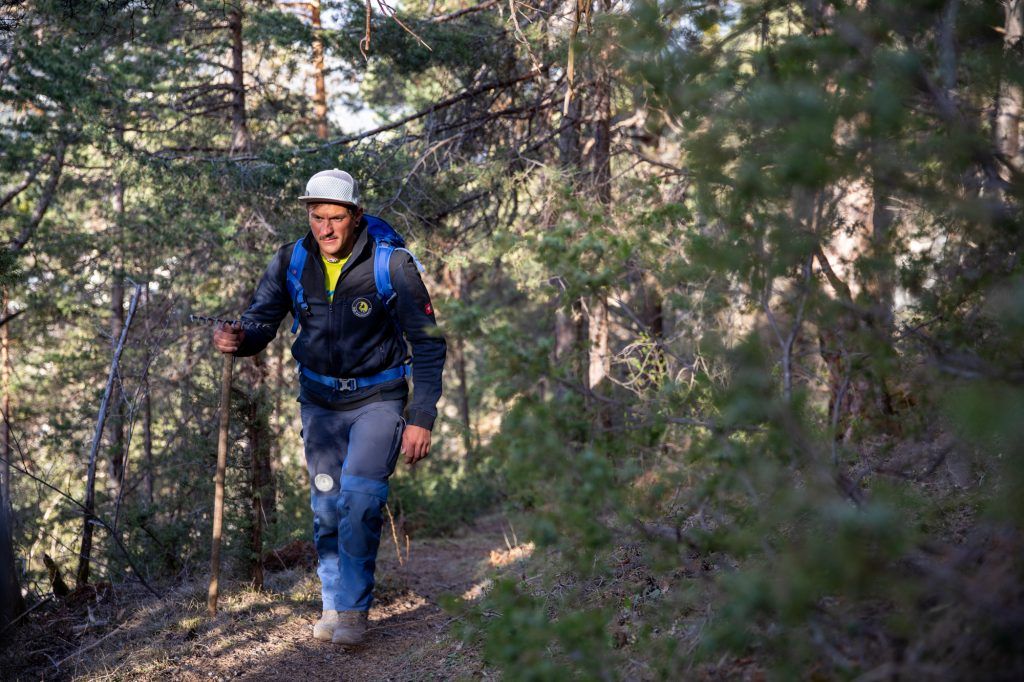
Instead of a walking stick, Martin Gstrein is holding a coarse rake. The work begins right at the start of the access; lots of stones have been left lying on the narrow access path over the winter, and they need clearing away. A first sign that not everything seems to be quite as solid as it should be in the limestone ridge above Karres.
Once he’s reached the Rock Climbing Area itself, Martin’s first task is to stretch a red-and-white barrier tape – the sort you see on building sites – between a bolt and a small pine tree. ‘Closed today, unfortunately’, it says, because there’s going to be some work going on here today.
But first, the rope is unpacked and the climbing harness put on: time to assess the situation – or rather, the routes. This gives you a glimpse of why a good climbing area renovator should also be a good climber: first of all, they have to get up to the belay station; they need to have a feel for the area and the rock.
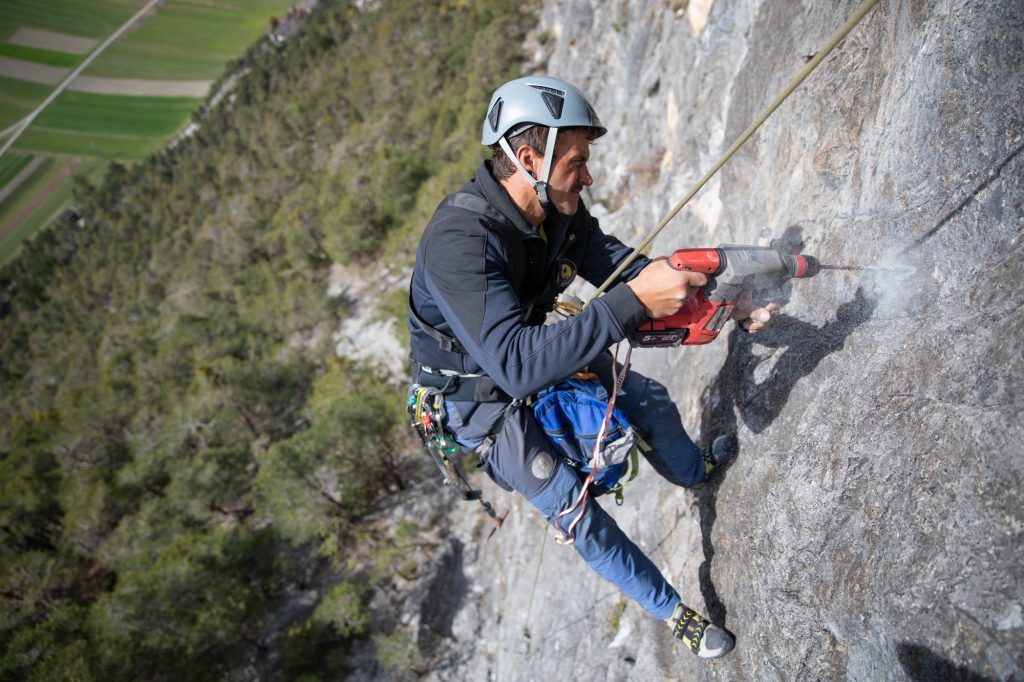
But today, Martin’s climbing harness is carrying far more than just the quickdraws normally needed for sport climbing here: a hammer, a drill, an angle grinder, spanners. A construction worker of the vertical kind.
The work for our maintenance team begins even on the way to the rock face – namely, by clearing the approach path. For Martin Gstrein, ‘his rake’ is part of his basic kit.
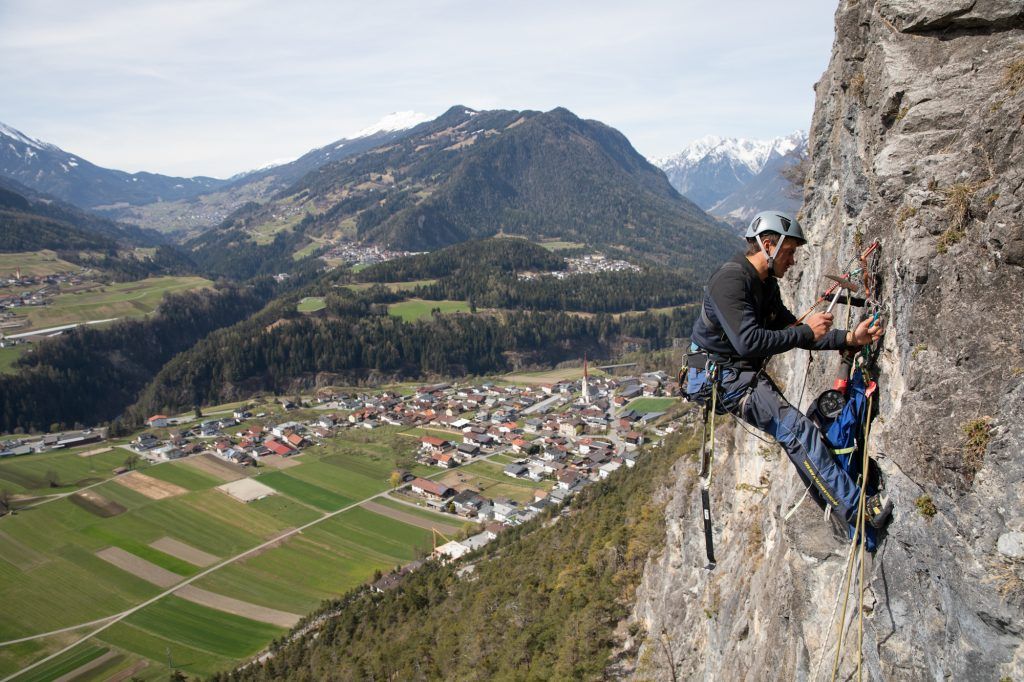
A very important element is the belay station itself: once at the very top, the climber clips the rope in so they can then lower themselves back down to the ground. There are many systems used for this around the world, but the gold standard is two bolts connected by a chain. The rope must then either be threaded through a ring or, as is now standard at Climbers Paradise Tirol, conveniently clipped into a carabiner.
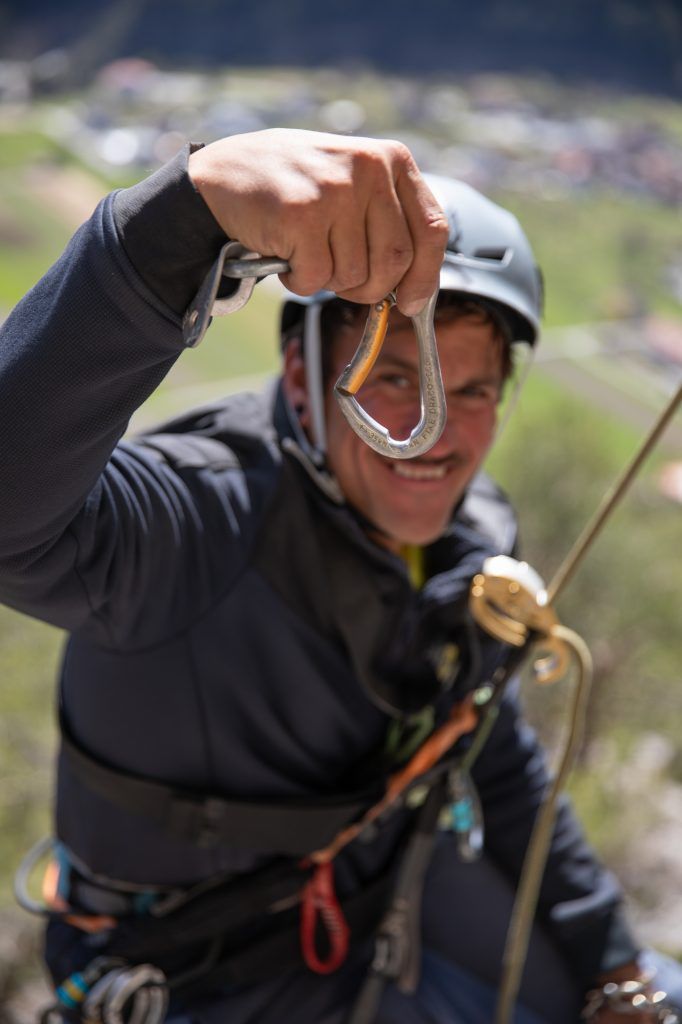
“Depending on how frequently a route is used, however, a carabiner like this will wear out over time due to the friction of the rope. This creates a characteristic notch on the underside. If this notch becomes too deep, however, it can become dangerous: The edges become increasingly sharp and, in extreme cases, can damage the rope,” explains Martin. That’s why one of the most important tasks for those maintaining the Rock Climbing Areas is to check the belay stations. And, as is the case today, to replace the belay carabiners if necessary.
To do this, Martin removes the old, worn-out carabiner and takes a brand-new stainless-steel carabiner from the Tirolean company AUSTRIALPIN out of his rucksack – one with a turquoise gate. The gate always faces forwards, and to prevent the carabiner from twisting, Martin drives a locking pin into it with his hammer. “Right then, so the belay station is now in perfect condition for the next two or three years – depending on how often the route is climbed,” says Martin proudly.
Thanks to the materials supplied by Climbers Paradise partner AUSTRIALPIN, only EN 959-compliant ‘Made in Austria’ equipment is used throughout. A contribution to greater safety and added value in Tirol!
Things get noisy when the whole belay station is replaced: the Hilti drill cuts through the limestone almost as if it were butter; a quick clear of the drilling dust from the hole, in goes the anchor, the plate on top, tighten it up, and it’s done. “You could almost hang a car off it now,” smiles Martin. The position of the belay station is also important: on the one hand, the rock itself must, of course, be rock-solid; to check this, Martin gently taps the rock in several places with a hammer.
“You can clearly hear a ringing sound; that’s how you know the rock is sound. But if it sounds hollow, you mustn’t drill there,” Martin knows from long experience. On the other hand, it’s also best to place the belay station behind a small ledge so that it’s better protected from falling rocks. And he tidies up afterwards too, using a brush to remove the drilling dust.
Sometimes new bolts have to be set as well. For example, if a flake of rock has become loose over the winter and needs to be removed. In that case, the old anchor point usually no longer fits and has to be ‘re-drilled’.
Once the belay station is sorted, Martin abseils from bolt to bolt, checking each one. He tightens a nut here, taps the rock with his spanner to test its solidity. And then: a new route, a new challenge!
After just one route, you get a sense that it’s going to be a labour-intensive day. There are almost 120 routes on the Rote Wand above Karres, and each route has, depending on its distance, ten or more bolts. All in all, that’s a huge amount of equipment embedded in the rock face that needs maintaining. This raises the question: who actually pays for all of this?
Rock Climbing Areas often spring up almost organically thanks to motivated locals, with the equipment funded out of their own pockets. In the official Climbers Paradise Tirol Rock Climbing Areas, however, there is always a clearly defined maintainer who takes care of the upkeep at regular intervals. This person is commissioned and funded by the relevant tourism board; in the case of Karres, that’s the Imst Tourist Board. And maintaining high standards for the equipment naturally comes at a cost: “A belay station with a carabiner costs around 30 euros, a bolt with an anchor around three euros – it all adds up,” says Martin.
Once the day’s programme is finished, Martin can’t resist testing out the routes himself straight away with the new, gleaming bolts. At last, he can put all the tools away and put on a normal climbing harness. With a newfound ease, Martin climbs a few enjoyable routes of Level of Difficulty 6 to round off the day – “since we’re already here” – high above the church tower in Karres. And he’s already looking forward to a shower; he’s covered from head to toe in a layer of dust.
On the way back, he takes his red barrier tape with him again – the job’s done. So that the next climbers can come and, without a single thought for safety, simply do one thing: climb without a care in the world and enjoy a brilliant day in the fresh air.
Understandably, belay carabiners are among the elements requiring the most maintenance in the Climbers Paradise Rock Climbing Areas. If they are worn down to a maximum of one-third of their original thickness, they are replaced immediately. In some cases, this happens up to twice a season!
The Climbers Paradise Tirol association is committed to ensuring the quality of the climbing infrastructure across all 15 regions and in over 130 sport climbing areas. Should anything go wrong, there is a central hazard reporting system on the Climbers Paradise Tirol website where anyone can report damage.
Is specialised training required for the maintenance of climbing gardens?
No, but you should definitely attend a bolting course; Climbers Paradise organises high-quality in-house training sessions for us, from which we always learn a great deal. The ‘Rock Climbing Area Handbook’, which was revised and republished in 2019, sets out the quality standards for Rock Climbing Areas and bouldering areas in detail. For those interested, there are also bolt-setting offers available through the Alpine Club or private providers.
How do you become a Rock Climbing Area maintenance manager at Climbers Paradise?
In my case, the tourist board approached me because they were aware of my expertise and local knowledge. However, anyone interested can also contact the relevant tourist board themselves and simply enquire.
What qualities are important?
Conscientious and meticulous work. A deep understanding of how to identify and remove potential hazards such as loose rock or trees. A sustainable approach to the natural environment.
How often is a Rock Climbing Area in Tirol maintained?
In the case of Karres, it’s twice a year. This can vary slightly depending on the Rock Climbing Area, but at least once a year.
In terms of equipment, what is important?
Only use tested and certified equipment, such as that supplied by Climbers Paradise Partner AUSTRIALPIN.
Peter Manhartsberger, Quality Manager at Climbers Paradise Tyrol partner AUSTRIALPIN, comments: “The quality of our products is our greatest asset. You can only guarantee this if you manufacture everything entirely in-house. That’s why all our metal products – from development and tooling right through to series production and quality assurance – are produced entirely in-house. We’re committed to quality ‘made in Austria’!”
Recommended links:
Standards for bolting: alpenverein.at – Overview of bolting
standards AUSTRIALPIN drilling equipment: austrialpin.at – Drilling equipment
„Our greatest asset is the quality of our products. You can only guarantee this if you manufacture everything entirely in-house. That is why all our metal products – from development and tooling right through to mass production and quality assurance – are produced entirely in-house. We are committed to quality ‘Made in Austria’!“
Tips & Safety
Would you like to find out more about climbing safety? Click here for our safety tips.
