Jakob Schubert – The Winner

8C bouldering, 9b routes and a whole host of World Cup victories. When it comes to difficult climbing, Jakob Schubert is the benchmark in Austria for routes with small holds and overhangs – whether they’re bolted or natural.
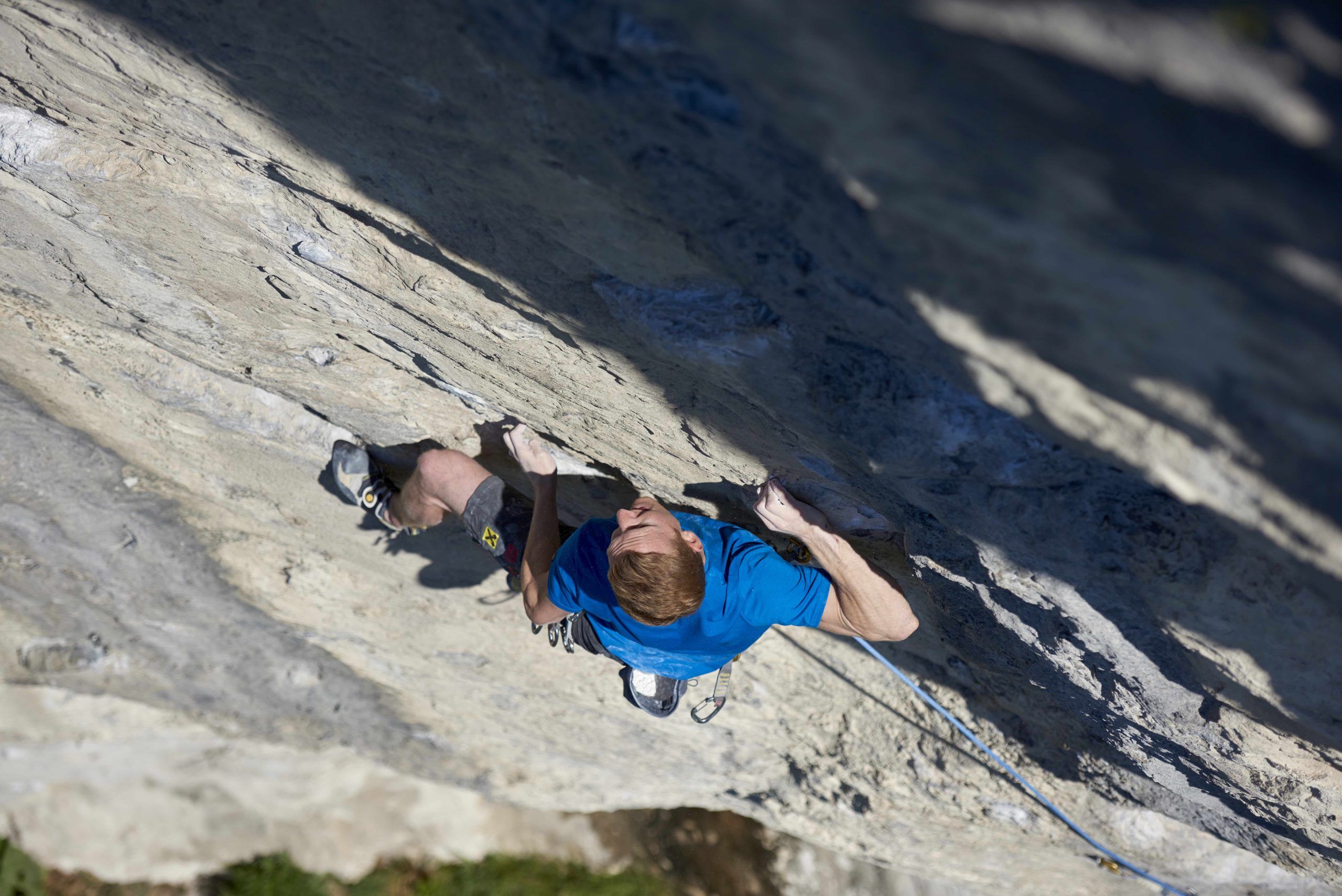
Jakob Schubert klettert die Route Swingtime im Sektor Dschungelbuch an der Martinswand

Two souls, one power station

Jakob’s versatility across different disciplines is as legendary as the speed with which he breezes through routes graded 9 on the French scale.

We spoke to the Innsbruck Kraftwerk about the Olympics, 9b+ and climbing as the new national sport.

Text: Flo Scheimpflug

Rock or plastic?

At competitions, you’re a regular on the podium; on the rock face, you tackle the toughest of the tough. To quote Goethe, there are ‘two souls within your breast’. But what does your heart beat for?

I simply enjoy both. But competition climbing has an expiry date; on the rock, on the other hand, you can climb forever. If my body holds up, I’d like to still be out there at 80.

You’re one of the few people to have climbed two 9b routes. Why is the name Jakob Schubert mainly associated with competition climbing?

It’s quite simple: during the build-up to competitions, there’s often no time for rock climbing for months on end, so you tend to disappear from the radar a bit.

Where do your roots lie – on natural rock or on artificial walls?

Right at the start, I did some outdoor courses, but I really got started in the climbing centre when I was about twelve. That’s how I got into outdoor climbing.

Is it actually a misconception that people who come from indoor climbing struggle on the crag? Even if they’re already incredibly strong indoors?

Not at all, because there are major differences between the two disciplines. In the gym, it’s quite easy to work out what to do – the holds are colour-coded. On the crag, you have to find everything yourself, and on top of that there are several variations, not just the route-setter’s intended line. Outdoors, I’ve often noticed that many people struggle at first on the rock. We all know how difficult a 6c slab can be!

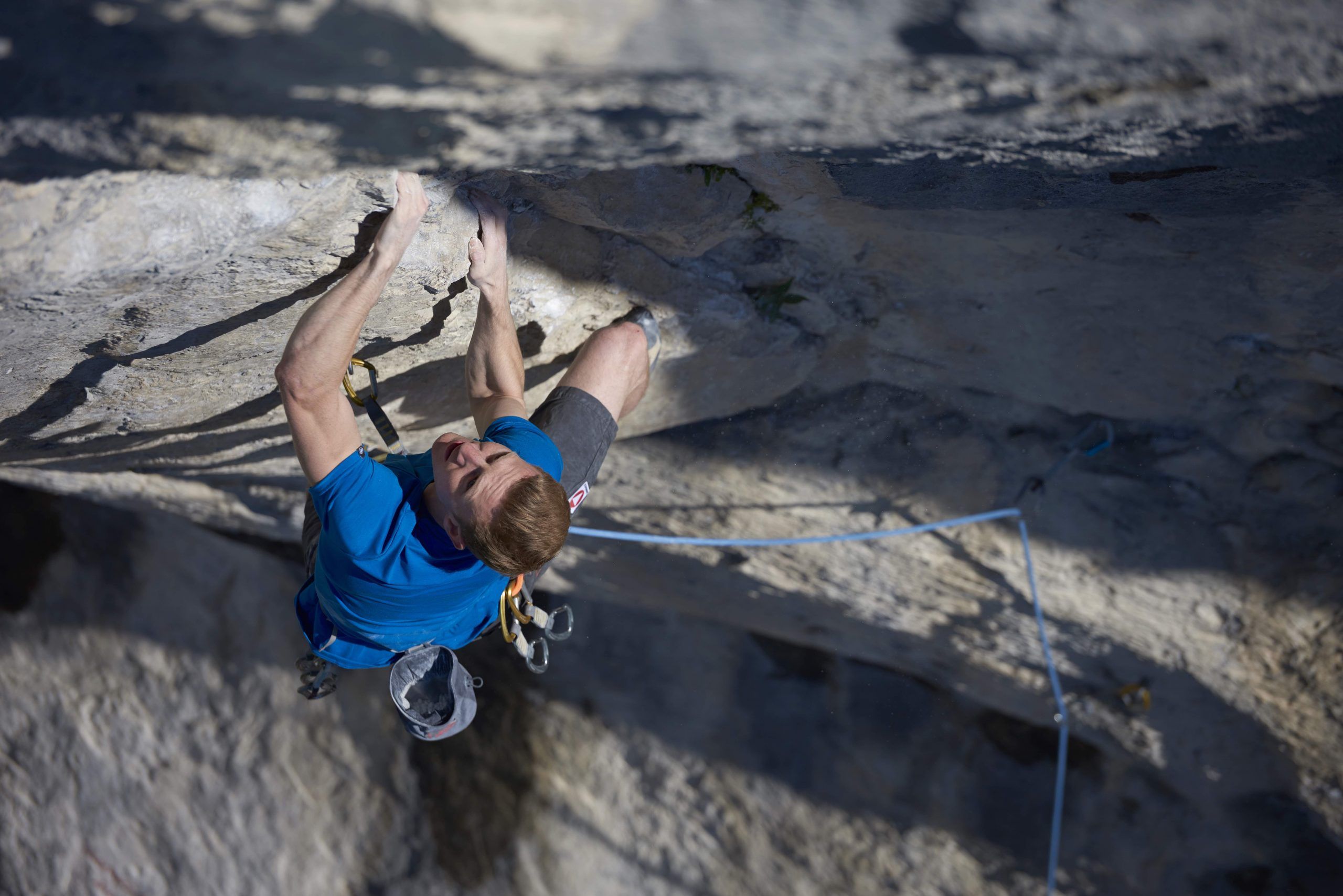
„Just because you can climb in Hall 8b doesn’t mean you’ll be able to do the same on a real rock face straight away.“

Jakob Schubert on the overhanging rock of the ‘Swingtime’ route on the Martinswand

Training, the World Cup and two disciplines

The competition calendar is incredibly packed – how do you still find time for the crags?

It’s true that sometimes training is more important to me than going out to the crags. Especially when a competition is coming up. During the build-up phase, I’m in the gym five times a week and train for between 25 and 30 hours, so there’s not much time left. But I’ve realised that climbing on the rock is sometimes the best training.

Is outdoor climbing good for bouldering?

Yes, especially for Bouldering. You don’t get holds and footholds as tricky as those on the rock in the gym. And when we set up a boulder in training that we can’t manage, we move on to the next one. But on the rock, I know that someone has already done those moves. So of course I keep trying, because I want to manage it too. There’s hardly any better IMT (intramuscular coordination training, ed.) than that.

In the World Cup, you compete in both Bouldering and Lead climbing. Did one discipline not challenge you enough?

Like almost all competitive climbers, my roots are in lead climbing. But to be successful there, you also have to do a lot of Bouldering – and I’ve actually always enjoyed that.

You’ve achieved something that hardly anyone manages: winning World Cups in both disciplines.

I trained a lot with Kilian (Fischhuber) and at some point realised: ‘Hey, I’m not that much worse than him.’ That gave me quite a lot of self-confidence, and I knew that a victory in Bouldering was also possible.

The Olympics and the new national sport

In competitive climbing, the Olympics are the big topic, aren’t they? You’ll be taking part in 2020. Are you dreaming of an Olympic place too?

I certainly see the whole thing in a very positive light, although, like many others, I’m not exactly thrilled with the combined format (Lead–Bouldering–Speed). You don’t see that in any other competition. Ideally, just like in the World Cup, there’d be three disciplines. But that’s not possible, because the IOC has only allocated one medal. I hope that we perform so well in 2020 that we’ll get three medals at the next Games.

Growth figures that other sports can only dream of, international successes galore – is climbing set to become the new national sport?

First of all, the media – and above all television – would have to get on board. I can’t imagine that Alpine Skiing will ever disappear as part of our national identity, even if there’s virtually no snow left. Whether climbing becomes a national sport or not, I really don’t mind.

8C bouldering, 9b routes – what’s next?

With ‘Bügeleisen sit’ (8C) in the Maltatal (AUT) or ‘Fight or Flight’ (9b) in Oliana (ESP), you’ve climbed the toughest of the tough. What’s next?

Whatever comes my way! Repeating routes, pushing myself to the limit or pushing it further – that’s what I find most exciting. 8C boulders, 9b routes: I want to keep at both.

Anyone who climbs 9b will eventually have a go at 9b+ …

Yes and no. There are quite a few 9b’s now, but the selection of potential 9b+ routes is limited. There are only three (‘Vasil Vasil’ in the Czech Republic, ‘La Dura Dura’ in Oliana, ‘Change’ in Norway) and they’re all extremely unique. I don’t know anyone who’s currently trying any of them.

Places not to be missed in Tirol

What are your ‘must-visit places’ in Tirol?

I’ve spent most of my time in theÖtztal and Zillertal valleys. I’ve also made a few first ascents there: ‘Grantiger Bauer’ (8c+/9a) on the Saustein in the Zillertal and ‘Kein Licht, kein Schatten’ (9a) on the Elefantenwandl in the Ötztal. I’d really love to check out Achleiten one day.

And what about the potential for 9b routes in Tirol?

I’ve certainly heard of some impossibly difficult projects, but I’ve never actually been there myself.

Highlights from the interview

You might also be interested in these articles