Climbing training with children

From primary school age onwards, children are mature enough to learn how to climb – and, above all, how to belay – properly. Coach Matthias Bader explains why this isn’t about the next competition – but about the next fifteen years.
Kind klettert bei einem Wettkampf an einer Kletterwand

Slowly but surely: the build-up

Children’s climbing training is all about building performance over the long term. The aim isn’t next month’s competition, but rather to develop their potential as teenagers and young adults.

From primary school age onwards, children are mature enough to learn how to climb properly and, above all, how to belay. The first competitions take place from the Minis category (U8 and U10).

Text and photos: Matthias Bader

Why not everything is practised at once

As every body adapts to training, the intensity of the training must be increased over the years. That is precisely why this should not happen too early: so that, during the prime or most important years – which in sport climbing currently range from around 18 to 25 – the body can still be challenged in new ways.

Anyone who has already pushed themselves to the limit by the age of twelve will have nothing left in reserve by the age of twenty.

Critical phases as the key to success

Training should be tailored to what are known as ‘sensitive phases’. For both boys and girls, there is always a certain age range during which specific skills can be developed particularly effectively. If this window of opportunity is missed, it may mean that the same training benefits can never be achieved again with the same level of success.

For young children, for example, flexibility is very important and should always be included in training – as should speed.

And most importantly: children should climb frequently and in a variety of ways, learning and mastering climbing techniques.

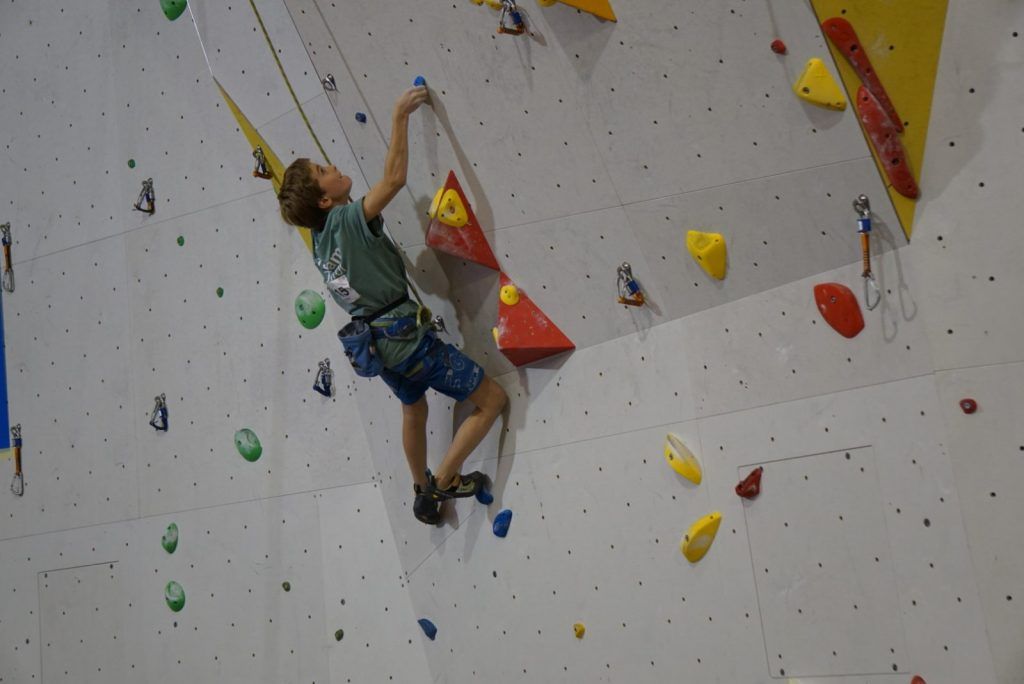
Children at climbing training in the indoor climbing centre

Watch out for growth joints!

When training children to climb, particular attention should always be paid to the risk of injury. The growth plates in children’s and teenagers’ fingers are particularly vulnerable. Until these have fully closed, certain training methods – particularly the grip board – are off-limits.

In summary: there is a great deal to bear in mind when training children to climb. And the earlier they receive professional supervision, the greater the chances that they will remain committed to the sport and not lose their motivation.

At a glance

  • Starting age: from primary school age, ready for proper climbing and belaying
  • First competitions: Minis category (U8 and U10)
  • Target age range: in sport climbing, peak performance is currently around 18 to 25 years of age
  • Always train these too: flexibility and speed
  • The crux of the matter: climb frequently and varied routes; make technique second nature
  • Off-limits: fingerboards and the like whilst growth plates are still open
  • Rule of thumb: Gradually increase the intensity of training over the years – don’t push yourself to the limit all at once
Child climbing on the rock face

And then out to the rock

The indoor crag is for training; the rock face is the reason why you train. Anyone wanting to make the transition from artificial holds to real rock with children is best off looking for areas with a gentle approach, short access and routes that don’t demand too much from the start. Four classics in Tirol:

  • Flämenwandl / Leutasch – 23 routes ranging from 3 to 6b+, 4 to 16 metres, gentle access from the car park, barbecue areas and the Leutascher Ache river right next to it.
  • Mauerbogen / Leutasch – 31 routes ranging from 3 to 7, 15-minute Access. Note: the grades are considered rather tough; it’s best to start one grade lower.
  • Imst / Reithle – over 60 routes on conglomerate boulders up to 15 metres high, easy access from the base of the wall, plenty of shade. Includes bouldering traverses.
  • Nassereith / Botanical Garden – the family-friendly sector in the large Rock Climbing Area above Nassereith.

And if your fingers do get tired: the crash pad afternoon at Mandlers Boden in the Pitztal valley can be enjoyed without a rope.

Child-friendly areas featured in this article

You might also be interested in these articles