Climate-friendly climbing – 3 spots in Tirol that are easily accessible by bus, train or bike

A quick trip to the crag after work, pack the essentials into the car, and off we go. The two authors, Deniz Scheerer (botanist) and Lena Müller (ecologist), have made a conscious decision to do without this luxury. They want to play their part in bringing about the sustainable change our planet so urgently needs.
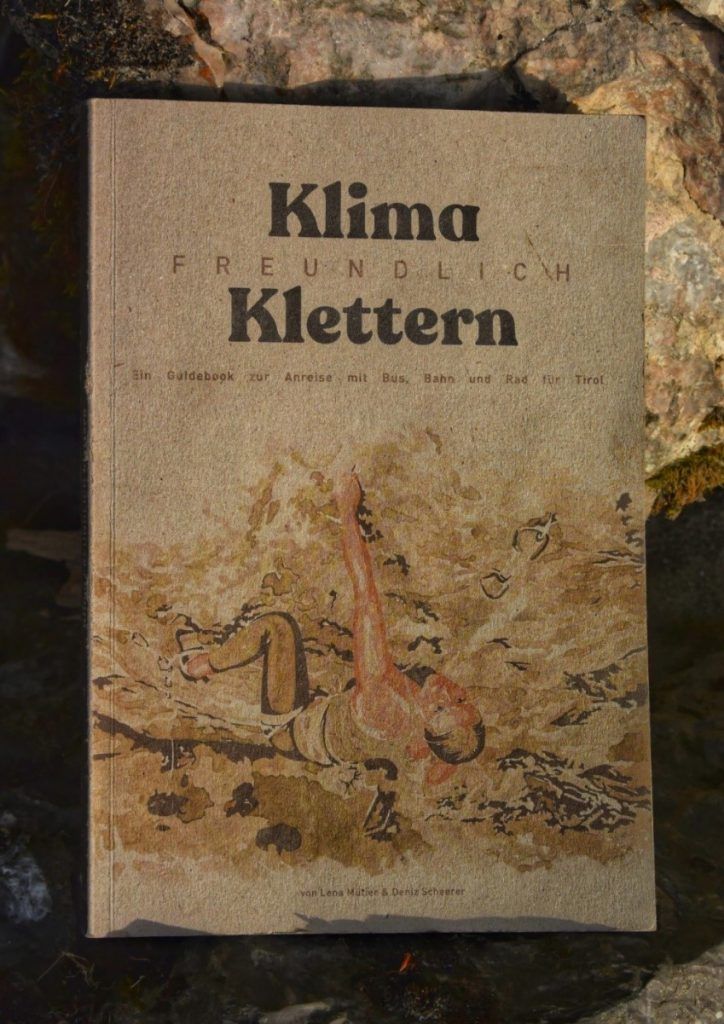
Cover des Sustainable Climbing Guide von Deniz Scheerer und Lena Müller

The Sustainable Climbing Guide

In their ‘Sustainable Climbing Guide’ (available free of charge at the Innsbruck Climbing Centre or online at lenamueller.com), the two climbers focus on eco-friendly ways to reach around 21 climbing areas in the Mieminger Mountains, the Ötztal, the Seefeld Plateau, Innsbruck, Achensee and Kufstein – providing detailed information on travelling by bus, train, bicycle or on foot.

Once you have come to terms with the climate changes heavily influenced by human activity and reflected on your own actions, this will, in the best-case scenario, lead to changes in your own lifestyle – be it adopting a vegetarian or vegan diet, avoiding air travel, or travelling to the climbing area by public transport.

A few facts from the climbing guide to get you in the mood:

  • “In 2021, the world consumed the resources of 1.5 planets. If the entire world population were to live according to the Austrian way of life, it would be as much as 3.5 planets.”
  • “In Austria alone, more than 6,700 tonnes of plastic particles enter the environment every year through tyre wear – the weight of 1,000 elephants.”
  • “On average, around 35 per cent of a person’s carbon footprint is attributable to consumption, 20 per cent to transport, 20 per cent to housing and 15 per cent to food.”
  • “A car with a combustion engine emits on average 15 times more CO₂ per passenger-kilometre than a train in Austria.”

In this interview: author Deniz Scheerer

Climbers Paradise: Hi Deniz, how did you come to adopt a more sustainable lifestyle – and apart from travelling in a climate-friendly way, what else do you do to minimise your carbon footprint?

Deniz: “I got into the eco-friendly way of life quite early on. By the age of 13, I was already a vegetarian for environmental reasons. Through my biology degree, I’m involved in various organisations focusing on raising awareness and mobility, and I give talks on these topics. I also use public transport to get to work, go on holiday in the local area from time to time, and avoid short-haul flights.”

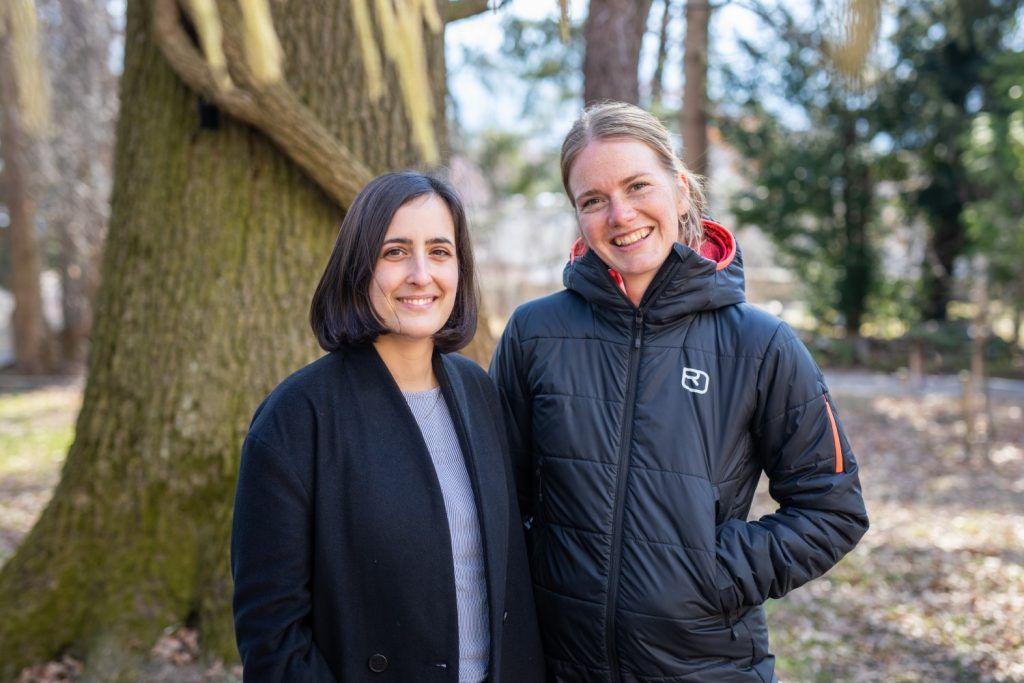
The authors of the Sustainable Climbing Guide, Deniz Scheerer and Lena Müller

Climbers Paradise: How does travelling in an environmentally friendly way affect your day’s climbing? Do your friends share your views?

Deniz: “As most of my friends don’t own a car, we actually always travel together by bus or train and then walk to the climbing spot. With the KlimaTicket Tirol, we pay 519.60 euros a year for all public transport. I don’t really see any downsides to this way of travelling.”

“It doesn’t take just a few people to do everything perfectly. It takes lots of people moving in the right direction.”

Climbers Paradise: Can you explain this quote to us in more detail?

Deniz: “For me, it’s not about making the ultimate sacrifice, but about which climate-friendly behaviours I can integrate into my everyday life without restricting myself. Some changes are even worthwhile for me personally: I make better use of my time on the bus than when driving – listening to podcasts, reading, making phone calls – or I do my body some good by cycling.”

Climbers Paradise: As a manager of a climate and energy model region, you have a realistic insight into how Tirolean politicians deal with nature conservation and climate protection. What’s your impression?

Deniz: “When it comes to climate protection, saving energy always comes first. With the 2050 Strategy – Tirol aims to be energy self-sufficient by then – politicians have a clear vision, and Funding from the federal and regional governments is currently favourable. However, I still see room for improvement when it comes to raising awareness: When I asked pupils in a rural secondary school class whether they’d noticed anything about climate change, none of them could give an example; when I mentioned the snowless slopes in winter, they simply said: ‘No problem, we’ve got snow cannons.’ Generally speaking, I’d like to see politicians making bold decisions.”

3 tips for Rock Climbing Areas that are easily accessible by public transport

“Together, we have the power to change everything.”

1) Martinswand, Zirl

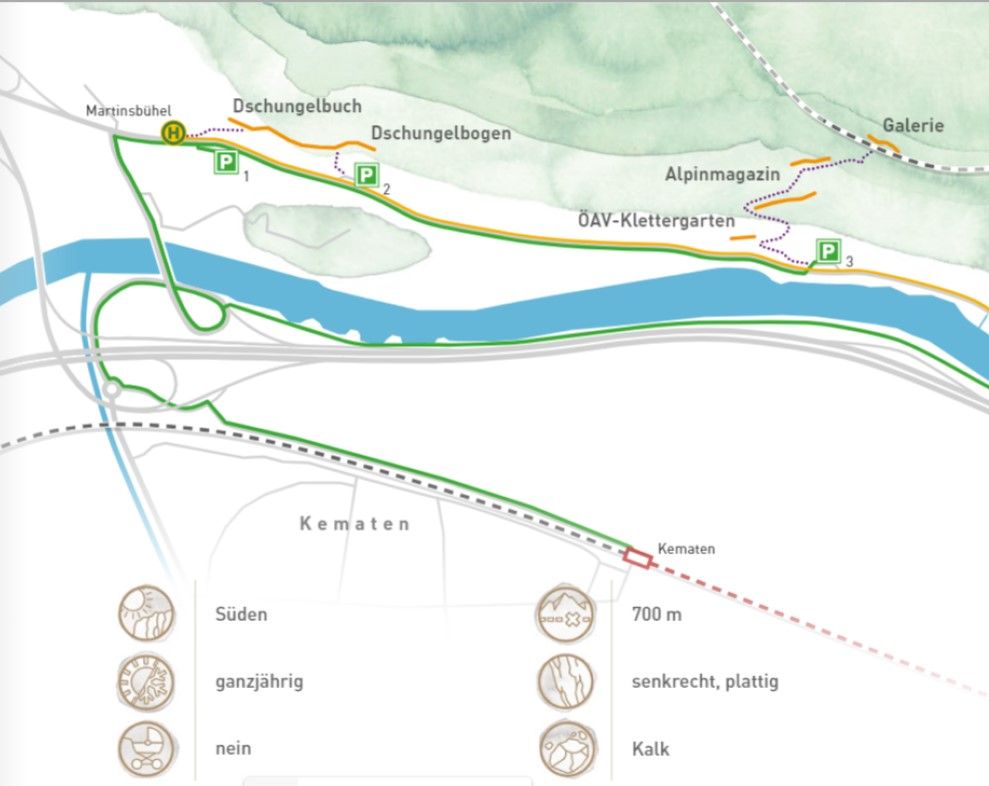
By bike (40 mins): From Innsbruck, follow the Inn Cycle Path upstream (on the left-hand side) to Kematen; at the end of the Cycle Path, turn right onto the L13, cross the bridge and turn right onto the B171; follow this road to one of the three car parks – the Access starts there. (12.6 km, ↑30 Altitude, ↓19 Altitude)

By bus (20 mins): From the ‘Innsbruck Finanzamt’ bus stop, take bus 4176 (towards Nassereith) or 4123 (towards Telfs) to ‘Zirl Martinsbühel’ (right next to P1). Alternatively, travel to ‘Zirl Gh Schwarzer Adler’ (more frequent services), then walk 15–20 minutes eastwards along the B171.

By train and bike (20 mins): From Innsbruck main station, take the S-Bahn (S4/S5), which runs every half hour, to Kematen i. Tirol, then cycle westwards along the railway line, via the L13 and B171, to the car park. (2.7 km, flat)

Overview of the Martinswand Crag near Zirl
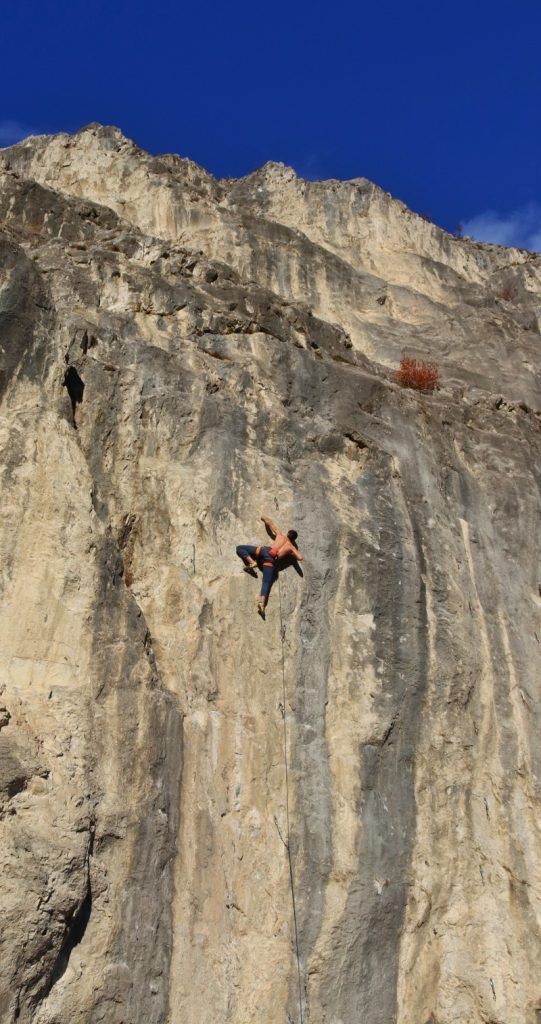
Climbing the ‘Dschungelbuch’ route on the Martinswand

2) Mieminger Mountains (Haiming Rock Climbing Area)

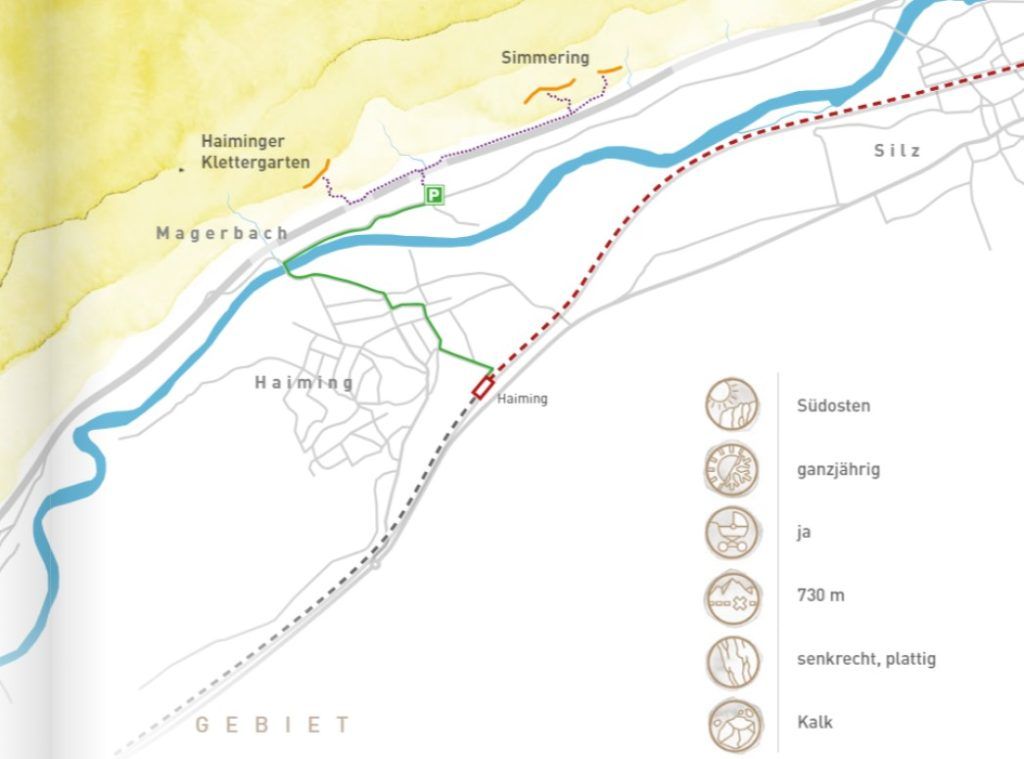
By train (35–43 mins): From Innsbruck Central Station, take the train (35 mins) or the S-Bahn (S5 towards Ötztal Bahnhof; 43 mins) to Haiming Station.

Continue by bike (6 mins) or on foot (20 mins): From the station, follow the railway path into the village until you reach the junction, then take Kirchstraße; at the end, turn left onto Dorfstraße, go straight on and turn right onto Ötztaler Straße, then turn left onto Alte Bundesstraße. Follow this road, cross the Inn bridge, then turn right onto Magerbach – shortly after the last houses, the hiking car park is on the right. The Access route starts from here (10 mins). To reach the Simmering Rock Climbing Area, head from the hiking car park through the motorway tunnel and then turn right.

Overview of the Haiming Crag in the Mieming Mountains

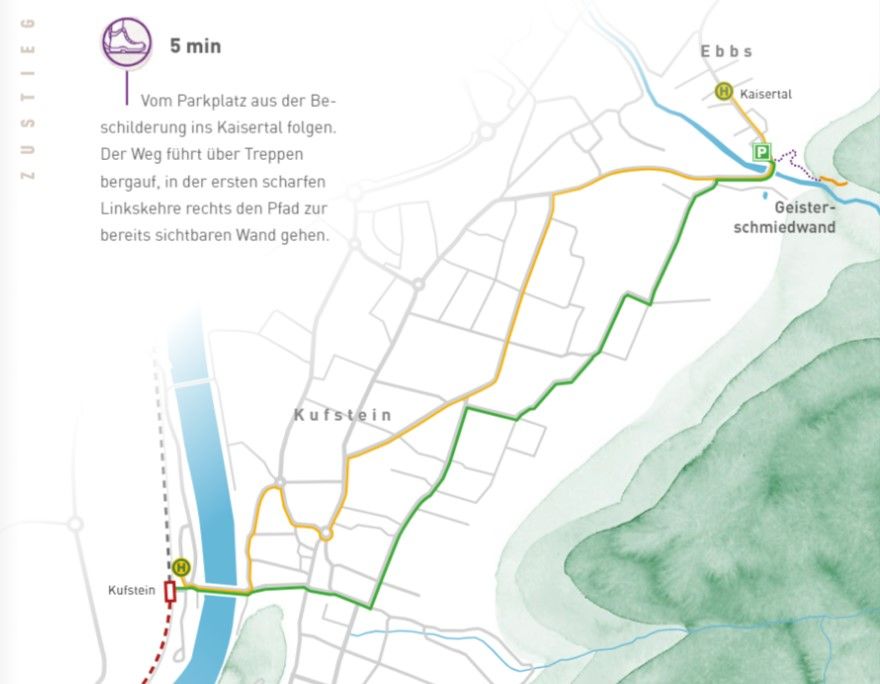
3) Kufstein (Geisterschmiedwand)

By train (35–75 mins): From Innsbruck Central Station, take the train (35–48 mins) or the S-Bahn (S4; 75 mins) to Kufstein Station.

Continue by bike (10 mins) or on foot (40 mins): From the station, cross the River Inn, head straight across the town square, turn left onto Andreas-Hofer-Straße until you reach the Kaiserlift Kufstein, pass the car park and follow Sparchner Straße to the Kaisertal car park – access starts from here. (2.8 km, ↑123 Altitude, ↓6 m)

Alternatively, by bus (6–18 mins): From the station, take bus 4030 (6 mins, towards Kössen Hüttwirt), 4036 (7 mins, towards Ebbs Schulzentrum) or bus 1 (19 mins, towards Ebbs Kaisertal) to the Ebbs Kaisertal stop, right next to the car park.

The Rock Climbing Areas featured in this article

Overview of the Geisterschmiedwand near Kufstein
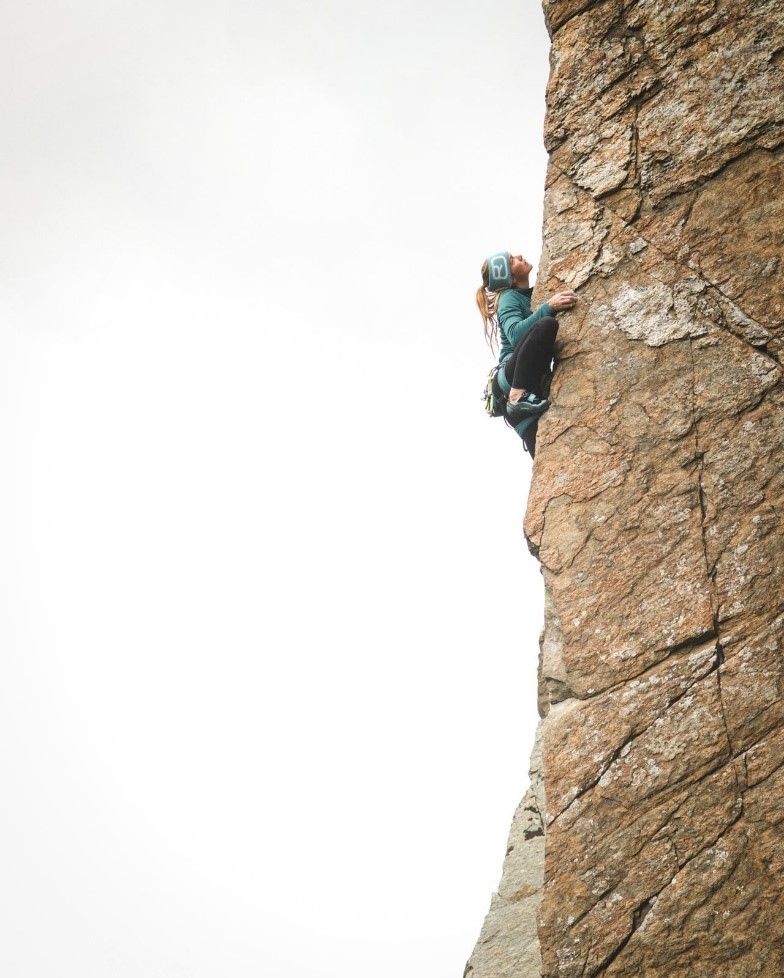
Climber Lena on the Engelswand in the Ötztal

More on climate-friendly climbing

Ecopoint: Redpoint is clear – climbing a route without falling or using the bolt to pull yourself up. Ecopoint? Not quite so clear yet, but hopefully soon: the Ecopoint concept extends the redpoint to include travelling to the crag by fair means – public transport, cycle, boat or on foot.

With the ‘Climbing with Respect’ initiative, Climbers Paradise is placing the spotlight on treating nature with respect.

You might also be interested in these articles